Industry Knowledge
DIN 934 Thread Tolerance Class 6H: What It Controls and Why Interchangeability Depends on It
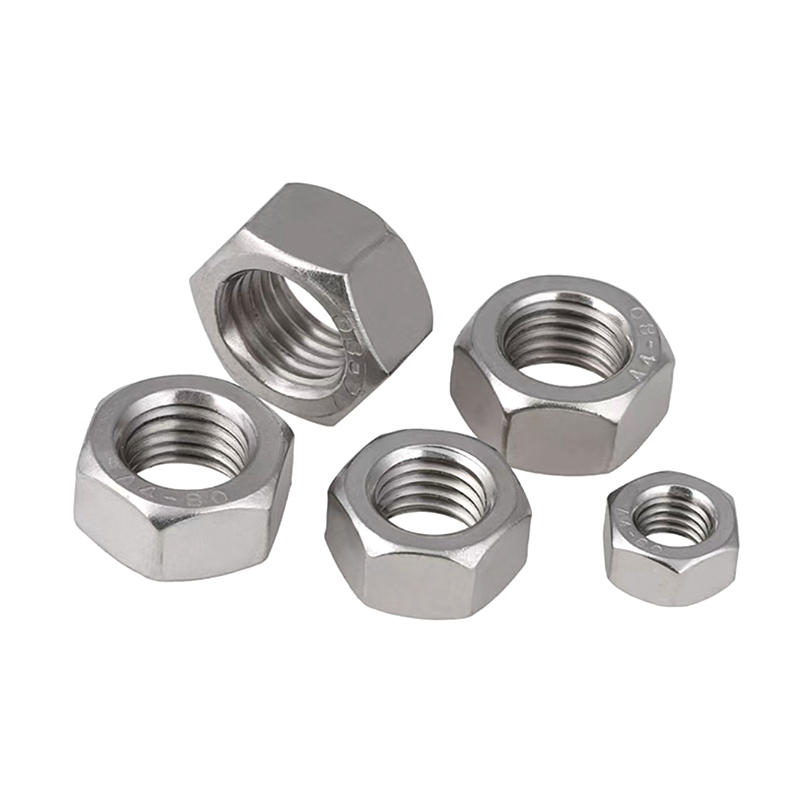
The 6H thread tolerance designation on DIN934 Hex Nuts is not a general quality rating — it is a specific dimensional control that defines the permissible variation in the nut's internal thread pitch diameter and minor diameter relative to the basic thread profile. The "6" denotes the tolerance grade (a measure of the total tolerance band width), and "H" denotes that the fundamental deviation — the position of the tolerance band relative to the basic profile — is zero for internal threads, meaning the minimum material condition of the nut thread coincides exactly with the nominal thread form. This zero-deviation positioning is what makes DIN 934 interchangeable with bolts manufactured to ISO 4014, 4017, and GB/T 5782 without selective fitting: any 6H nut will assemble freely with any 6g bolt (the standard external thread tolerance for metric bolts) across the full tolerance band of both components.
The practical consequence of 6H tolerance control is a defined thread engagement clearance that falls within 0.026–0.150 mm for M10 threads, varying with pitch and diameter. This clearance is large enough to allow assembly without galling under normal handling conditions, but small enough to limit lateral play between bolt and nut threads that would reduce the effective thread contact area and lower the fatigue resistance of the joint. When nut thread tolerance is relaxed beyond 6H — as occurs with some low-cost commodity nuts produced to non-declared tolerances — the actual pitch diameter variation can be 30–50% larger than the 6H band, producing assemblies that feel loose during hand installation and have measurably lower thread stripping resistance under proof load testing, even when the nut's hardness and tensile properties appear to meet grade requirements.
For procurement teams sourcing DIN934 Hex Nuts in volume, thread tolerance verification should be included in incoming inspection beyond visual and dimensional checks on width-across-flats and nut height. A go/no-go thread gauge set calibrated to 6H limits provides the only reliable field verification of thread form compliance — a step that is standard practice in automotive fastener receiving inspection but frequently skipped in general industrial procurement, where thread tolerance failures typically surface only after assembly problems occur in production.
Matching DIN 934 Performance Levels to Joint Load Type: Proof Load, Yield, and Fatigue as Separate Design Criteria
Nut performance level selection for DIN934 Hex Nuts is frequently reduced to a single question — "how strong does it need to be?" — when joint design actually requires three separate load criteria to be evaluated independently: proof load resistance, yield behavior under static overload, and fatigue life under cyclic loading. A nut that passes all three criteria at Grade 8 may be inadequate at Grade 8 in a fatigue-dominated application even though its static load capacity is never approached in service.
| Performance Level |
Proof Load Stress (MPa) |
Paired Bolt Grade |
Hardness Range (HV) |
Governing Failure Mode |
Typical Application |
| Grade 6 |
510 (M16 and below) |
6.8 |
130–302 |
Thread stripping |
General assembly, light structural, non-critical fixtures |
| Grade 8 |
800 (all sizes) |
8.8 |
200–353 |
Bolt fracture (desired) |
Mechanical equipment, automobiles, steel structures |
| Grade 10 |
1040 (all sizes) |
10.9 |
272–353 |
Bolt fatigue fracture |
Wind power, rail transit, heavy construction machinery |
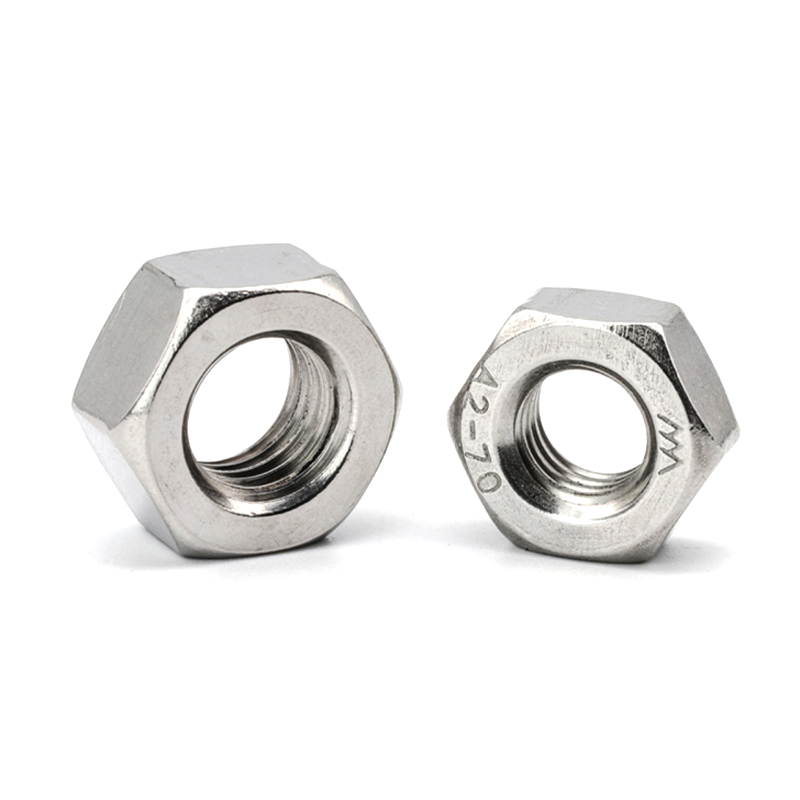
| A2-70 (304 SS) |
600 |
A2-70 bolt |
175–270 |
Corrosion / SCC |
Food machinery, chemical equipment, coastal structures |
| A4-70 (316 SS) |
600 |
A4-70 bolt |
175–270 |
Chloride pitting / SCC |
Marine engineering, offshore platforms, chlorinated process environments |
DIN 934 hex nut performance levels by proof load, paired bolt grade, hardness, governing failure mode, and application.
The fatigue dimension is the most frequently neglected in grade selection for Grade 10 applications such as wind power tower flanges and rail transit bogie connections. In these joints, the bolt-nut assembly experiences cyclic tensile loading from wind thrust, rotor imbalance, or wheel-rail dynamic forces at frequencies that can reach 5–20 Hz over a design life of 25 years — accumulating over 10⁹ load cycles. At this cycle count, the governing failure mode is not static thread stripping but fatigue crack initiation at the first engaged thread root of the nut, where stress concentration factors of 3–5× the nominal thread stress are generated by the thread helix geometry. Grade 10 nuts have a higher hardness range (HV 272–353) than Grade 8 (HV 200–353), which increases the thread root's fatigue strength and resistance to crack initiation, providing the fatigue life margin that Grade 8 cannot guarantee in high-cycle infrastructure applications.
Stainless Steel Stress Corrosion Cracking in DIN 934 Nuts: What Chemical and Marine Engineers Must Know
Specifying 304 or 316 stainless steel DIN934 Hex Nuts for corrosive environments is well-established practice, but the failure mode of stress corrosion cracking (SCC) — which affects austenitic stainless steel in specific combinations of stress, temperature, and chemical environment — is less widely understood and represents the primary cause of unexpected fastener failure in chemical engineering and marine engineering applications where stainless was selected precisely for its corrosion resistance.
SCC in austenitic stainless steel (304 and 316) requires three simultaneous conditions: tensile stress above a threshold (typically 40–60% of yield strength), a specific corrosive species (most critically chloride ions, but also caustic alkalis and polythionic acids in process environments), and an elevated temperature (above approximately 60°C for chloride SCC). In a bolted joint, the tensile stress condition is always met — the nut and bolt assembly is maintained at or above proof load stress as a design requirement. This means that any stainless fastener operating in a chloride-containing environment above 60°C has two of the three SCC conditions satisfied by design, and the third (chloride concentration) depends entirely on the operating environment.
- Marine engineering above the waterline — Atmospheric chloride concentrations in coastal and offshore environments are sufficient to initiate SCC in 304 stainless above 60°C, which can be reached by solar heating on exposed deck hardware. Grade 316 (A4-70) provides improved SCC resistance due to its 2–3% molybdenum content, which raises the critical pitting potential and slows chloride penetration into the passive film. However, 316 is not immune to SCC — in highly concentrated chloride environments or under crevice conditions (beneath the nut bearing face where oxygen is depleted), SCC can still initiate in 316 at temperatures above 70–80°C.
- Chemical engineering process lines — Polythionic acid SCC is a specific failure mode in refineries and petrochemical plants where stainless steel fasteners are exposed to sulfur compounds during shutdowns when the equipment returns to ambient temperature and moisture is present. This mode is particularly insidious because it occurs during maintenance periods rather than during operation, meaning the damage accumulates when the plant is considered safe. Specifying stabilized grades (321 or 347 stainless) rather than standard 304/316 for fasteners in sulfur-containing process environments eliminates polythionic acid SCC by preventing the sensitization that makes standard austenitic grades susceptible.
- Food machinery with CIP cleaning systems — Clean-in-place (CIP) systems using hot caustic soda solutions (NaOH at 70–85°C) can initiate caustic SCC in 304 stainless fasteners at the nut-to-flange interface where caustic solution concentrates by evaporation. Maintaining 316 as the minimum stainless specification and ensuring adequate drainage at all fastener locations to prevent solution pooling reduces this risk significantly. Electropolishing the nut surface — standard practice for food-grade stainless components — also improves SCC resistance by removing the work-hardened surface layer from cold-forming operations that has higher residual stress and lower SCC threshold than the base material.
Surface Treatment Specification for DIN 934 Hex Nuts in Multi-Environment Projects
Projects spanning multiple exposure environments — a common situation in large industrial facilities, port infrastructure, and energy installations that include both indoor equipment rooms and outdoor structural connections — require surface treatment specifications for DIN934 Hex Nuts that account for the most severe exposure zone while remaining cost-appropriate for less aggressive areas. Applying the outdoor specification uniformly adds unnecessary cost; applying the indoor specification uniformly produces premature corrosion failures in exposed zones. A zone-based surface treatment schedule, mapped to the actual corrosion exposure categories defined in ISO 9223, is the engineering-correct approach.
- Electro-galvanizing (C1–C2 environments) — Appropriate for indoor controlled environments, heated equipment rooms, and dry storage structures where relative humidity is maintained below 60%. The 5–12 µm zinc layer provides adequate sacrificial protection for 10–20 years in these conditions, with the additional benefit of no dimensional impact on 6H thread tolerances above M8 when standard 8 µm deposits are specified. For M6 and smaller DIN 934 nuts, coating thickness must be specified carefully to avoid reducing the thread engagement clearance below assembly tolerance limits.
- Hot-dip galvanizing (C3–C4 environments) — Required for outdoor structural steel connections, exposed mechanical equipment bases, and port infrastructure in moderate marine atmospheres. The 45–85 µm zinc-iron alloy layer provides 500–1,000 hours salt spray resistance and 20–40 years atmospheric corrosion protection in C3 conditions. A critical dimensional constraint applies: hot-dip coating on DIN 934 nuts requires the thread to be tapped oversize before coating to maintain 6H tolerance class after the zinc layer is deposited. Failure to specify pre-tap oversizing results in nuts that will not assemble with standard 6g bolts after hot-dip processing — a quality problem that commonly emerges only during on-site installation on large projects.
- Dacromet coating (C4–C5 environments) — The preferred specification for coastal infrastructure, offshore support structures, and high-humidity industrial environments where standard galvanizing service life is insufficient. The 4–8 µm zinc-aluminum flake layer achieves 500–1,500 hours salt spray resistance despite its thin profile, with no hydrogen embrittlement risk — making it the mandatory choice for Grade 10 DIN 934 nuts where acid pickling required for electroplating is prohibited. The low coating thickness means no thread tap adjustment is required, preserving 6H tolerance compliance without additional process steps.
- Blackening with oil (C1 only) — Used where dimensional neutrality and non-reflective appearance are priorities — optical instrument housings, precision machine assemblies, and interior architectural steelwork. The 1–2 µm magnetite layer provides no independent barrier protection; corrosion resistance depends entirely on the oil or wax carrier retained on the surface. Not suitable for any outdoor or high-humidity application regardless of other protective measures in the assembly.
With a complete supply chain covering full specifications, full materials, and full grades of DIN934 Hex Nuts across all major surface treatment systems, Shanghai Soverchannel Industrial Co., Ltd. enables project procurement teams to consolidate multi-environment fastener schedules under a single supplier with consistent quality documentation — reducing the certification management burden that arises when different treatment specifications are sourced from separate vendors with separate inspection records. The company's full-process quality control system, developed through years of precision manufacturing at Nantong Jinzhai Hardware Co., Ltd., ensures that surface treatment verification is part of the outgoing inspection record for every batch, not an assumed property of the treatment process.


 English
 中文简体
中文简体 Português
 Español
 русский
 عربى
عربى